Santander switches on AI for all 185,000 staff as its 'AI-first' bet starts paying off
Santander has extended AI access from 40,000 to all 185,000 employees, with 280+ production agents and €35m in Q1 business value on the way to a €1bn target.
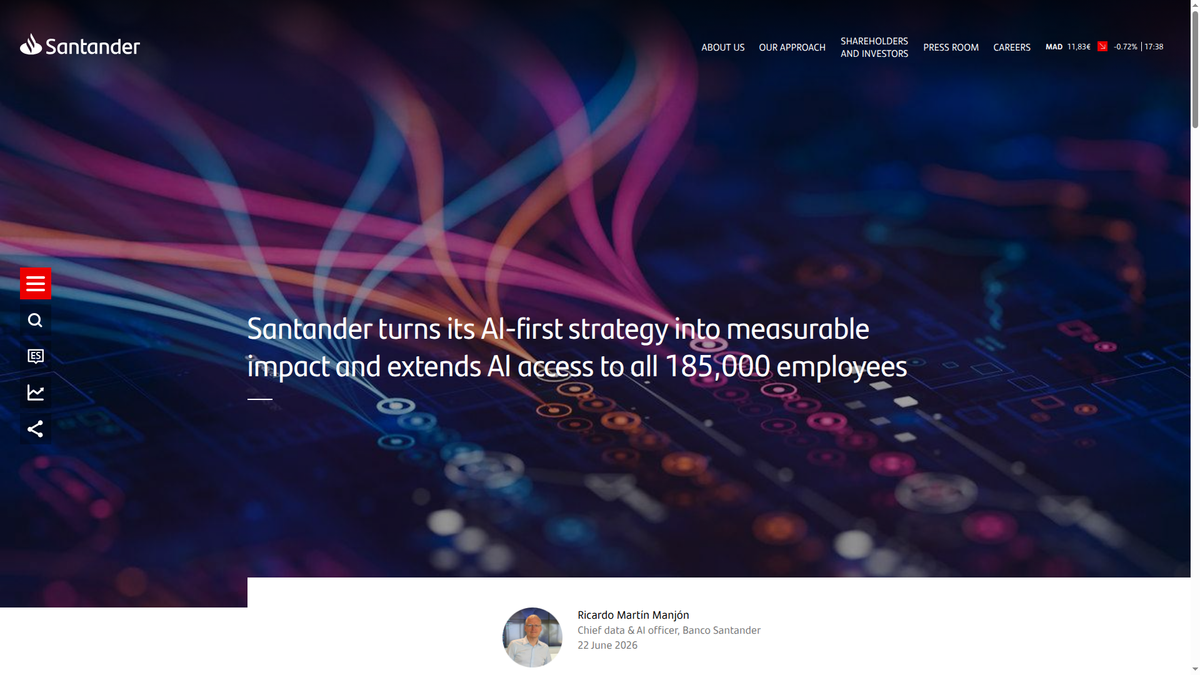
Santander has switched on AI access for all 185,000 of its employees worldwide, a sharp step up from the roughly 40,000 staff who were actively using the bank's AI tools before. The move, announced on 22 June, is being framed not as another experiment but as the moment the bank's "AI-first" strategy starts paying for itself.
The numbers are what make this one worth watching. Santander says it generated €35 million in measurable "business value" from AI in the first quarter of 2026 alone, and expects that figure to clear €200 million by year-end. The longer game is bigger: more than €1 billion in combined new revenue and cost savings from AI across 2026 to 2028.
"For me, being AI-first means applying AI where it can have tangible impact," said Ricardo Martín Manjón, Chief Data & AI Officer at Banco Santander. "Focus on fewer things that can truly move the needle, measure their impact and scale."
That discipline shows in where the bank is actually deploying the technology. For most of the 185,000 newly enabled staff, AI lands inside everyday productivity tools - preparing analysis, finding information faster, summarising documents, sharpening customer conversations and trimming internal admin. Santander has standardised on a mix of the major models, putting OpenAI's ChatGPT, Anthropic's Claude, Google's Gemini and Microsoft's Copilot in front of employees rather than betting on a single provider.
From copilots to agents
The more interesting layer is agentic. Santander now has more than 280 process-automation agents running in production across its functions, and the results it is citing are specific rather than hand-wavy:
- In Brazil, card fraud claims are processed 95% faster, with around 90% of the workflow automated.
- Openbank's AI models handle roughly 100,000 anti-money laundering alerts a year.
- In the UK, the bank is targeting 240,000 calls - about 40% of annual voice volume - for AI-assisted self-service.
- In Spain, AI now assesses credit-card eligibility at onboarding.
Software development is where the shift is most visible internally. By May, some 17,000 people were using agentic AI in development work, and by June the bank reckons AI was writing 40% of its code.
Agents that pay
Santander is also pushing into agentic commerce, the emerging idea that AI agents will transact on a customer's behalf. In March it ran its first controlled pilot of agentic commerce transactions across several Latin American markets with Visa, and became the first bank in Europe to test payments made by AI agents in partnership with Mastercard.
It is a notable pivot. Plenty of banks have rolled chatbots and copilots out to staff; far fewer are putting hard quarterly value figures next to them or letting agents touch the payments rail. Whether the €1 billion target holds up is the open question - but Santander has at least committed to measuring it, which is more than most.
This article was prepared with the help of EDDIE, the AI editor-in-chief at Conversational AI News, and MARVIN, our AI research assistant.