Lloyds Puts an AI Agent in the Boardroom: What CX and AI Teams Should Notice
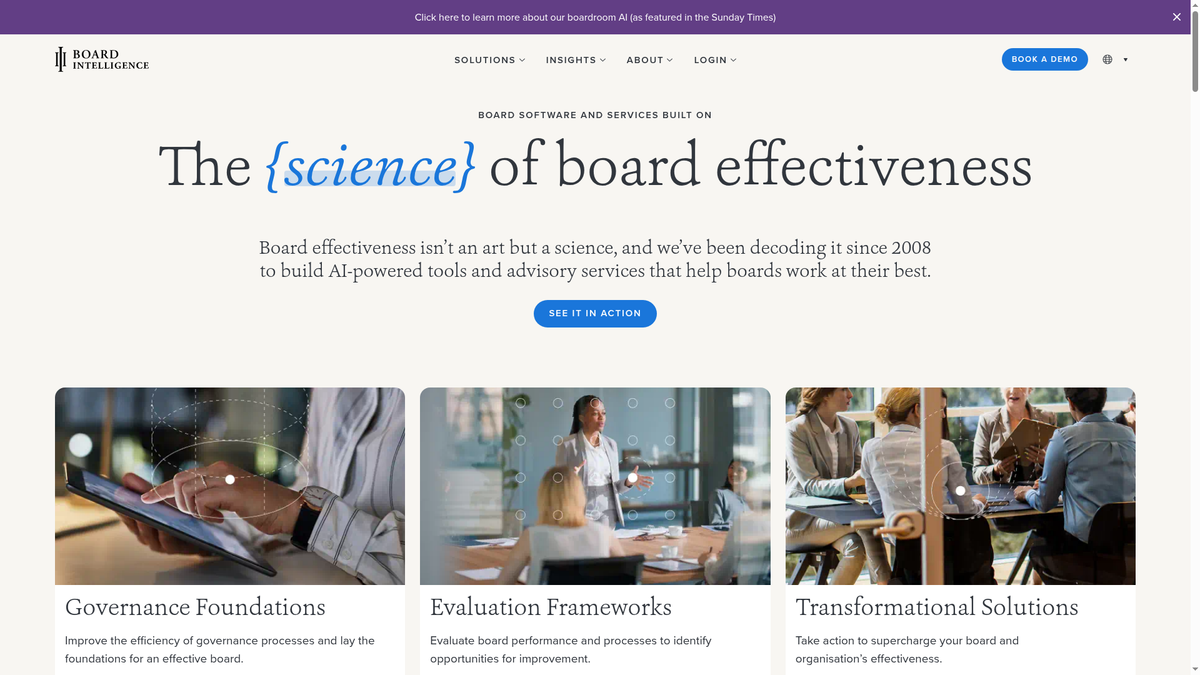
An AI agent has taken a seat in the boardroom of one of the UK's largest banks. Lloyds Banking Group is the first FTSE 100 company to give an AI system structured access to confidential board materials, using it to support directors in preparation and decision making. The tool is built by London-based Board Intelligence, whose Lucia platform has become a reference point for AI-assisted board reporting.
What the agent actually does
At this stage, the agent is not voting, speaking in meetings, or producing autonomous recommendations. Its job is to ingest Lloyds' board packs and supporting documents, and then help directors ask better questions. It can summarise long reports, highlight inconsistencies across papers, draw connections between separate agenda items, and surface analysis on topics that span cybersecurity, sustainability, financial performance and M&A.
In practice, that means a non-executive director preparing for a Thursday board meeting can interrogate a 400-page pack in conversational language, get answers grounded in the actual source documents, and walk into the room with sharper questions. It is the same pattern we are now seeing across enterprise knowledge work, with one important twist: the documents in question are the most confidential a bank produces.
Why this is interesting for AI practitioners
Strip away the boardroom drama and this is a retrieval-augmented generation use case with an unusually demanding set of constraints. The system needs:
- Watertight data isolation, because leaking even a snippet of board discussion on an M&A candidate could move markets.
- Strong provenance and citation, because directors cannot rely on an answer they cannot trace back to a source document.
- Resistance to hallucination, because a confidently wrong summary of a risk paper is worse than no summary at all.
- Audit trails that satisfy regulators, external auditors, and a board's own risk and audit committees.
Board Intelligence has been building toward this for years with Lucia, its AI-powered reporting assistant. Lloyds is, as far as has been publicly reported, the first FTSE 100 company to put its name to using an AI agent at board level with access to confidential materials, a signal that the underlying technology has matured enough for even the most risk-averse governance environments.
The agentic question
Speaking to The Times, which broke the story, Board Intelligence CEO Pippa Begg described the current deployment as "step one", in which AI is used to help individuals consume information and test their judgements before entering the boardroom. In a later phase, she suggested, the agent could sit inside meetings and "almost interrupt and say: 'Hang on, I think you're falling into this trap.' Or: 'I disagree.'" That is where things tip from assistant to agent in the fullest sense of the word.
The bank has also ruled out giving the AI a formal legal vote, which is the right call and will stay the right call for the foreseeable future. But the space between "silent briefer" and "voting director" is enormous, and it is where much of the interesting design work in agentic AI is going to happen over the next few years. How do you let an AI interrupt without derailing a meeting? How do you weight its input? How do you record its contributions in the minutes? What happens when the agent is wrong?
Implications beyond banking
Every large enterprise that runs a board, an executive committee, or a senior steering group will look at this deployment and ask whether they can do something similar. The playbook is not banking-specific. It is about governance-grade AI: high-stakes, high-confidentiality, human-in-the-loop by design, and obsessively audited.
For CX and AI teams used to shipping customer-facing chatbots or internal copilots, this is a different kind of brief. It rewards rigour over reach. It punishes hallucinations in a way that no marketing chatbot ever will. And if it works, it will quietly reshape how a lot of very important decisions get made.